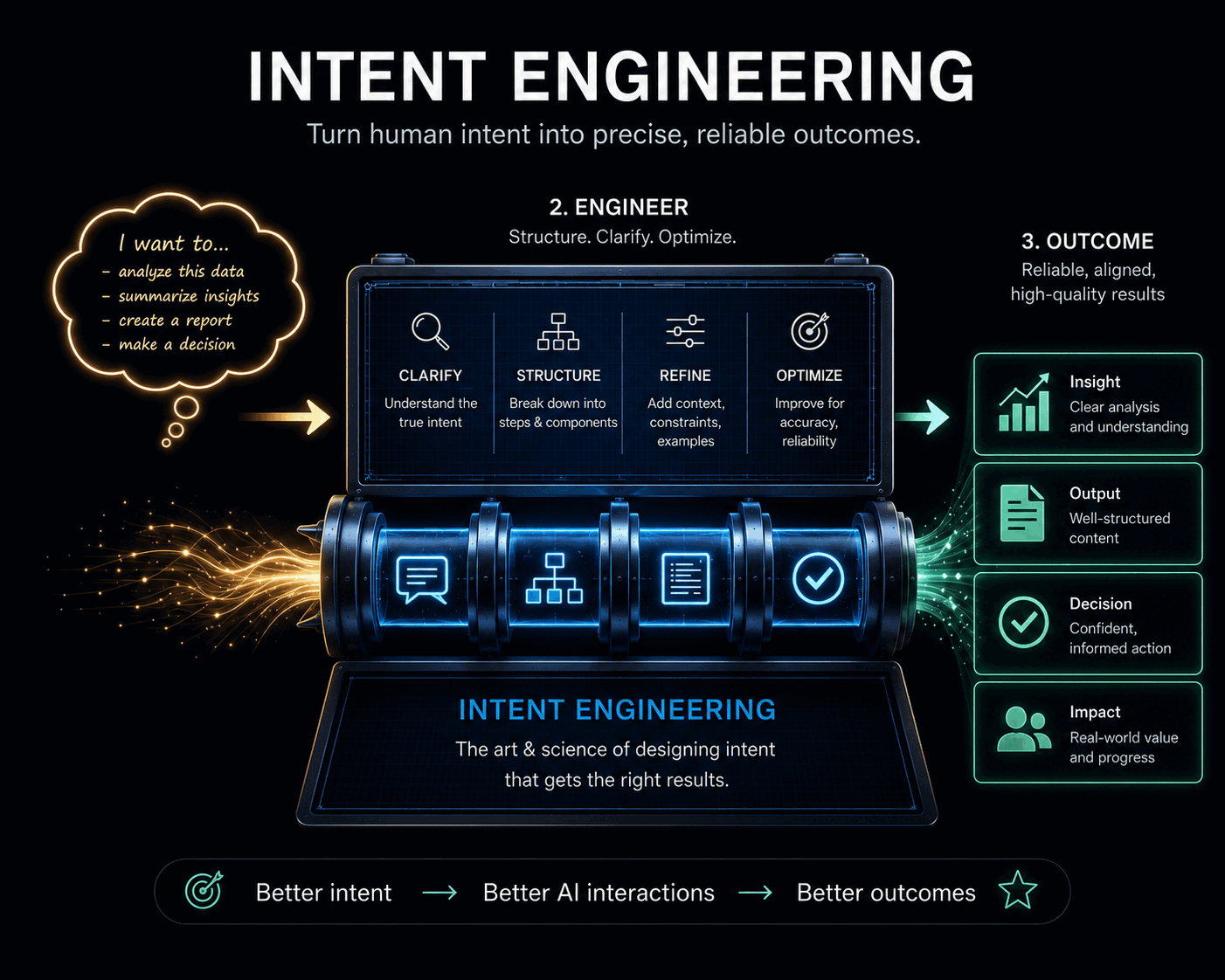
Intent Engineering isn't academic theory I'm writing about from the sidelines. It's a discipline I've developed running AI agents against real production workloads - at 175+ engineer scale, at 99.95% SLA, and across the 250+ production sites I've migrated with intent-driven workflows.
I've operationalized agentic AI across the full SDLC as production infrastructure, not sandbox tooling. Claude Code, GitHub Copilot, AWS Kiro, OpenAI Codex, and Gemini run as first-class CI/CD pipeline stages - code generation, test synthesis, cloud architecture scaffolding, documentation refresh. The outcomes that matter: 5x deploy frequency, 23% PR throughput gain, test coverage lifted from under 10% to 40% with no dedicated QA team, new-engineer onboarding cut 70%.
That track record is what taught me where AI agents actually break. They generate beautifully. They accomplish nothing. Technically excellent, strategically misaligned. The model isn't the problem - the missing layer is intent: what the agent must accomplish, how success is measured, what constraints apply, and when the workflow should stop or escalate.
That gap, between what agents can do and what the business needs done, is what Intent Engineering solves. Not a prompt library. Not another governance policy deck. Executable workflow design - ownership, permissions, evals, observability, approval paths, and measurable business outcomes wired in before an agent ever touches production.
The highest-leverage thing I do for a company is the judgment call on where AI earns its keep and where it actively makes things worse. That call is rock-solid because I have been writing software for two decades and leading engineers for fifteen years - and I still write code daily, migrating legacy stacks with AI-driven workflows, automating infrastructure with PowerShell and Cloudflare, shipping with Claude Code.
20+ years of hands-on engineering leadership, 13 of those as an IC before management. Not a consultant who draws frameworks on whiteboards. A practitioner who builds, deploys, and measures.